A Statement from CCPL’s President, Michael Wear
April 08, 2026
After a period of time in which social and political commentators were certain that religion was fading from relevance in American public life—that religious decline in America was inevitable–such certainty is harder to find.
Religious arguments are as common in the public square now as at any other time this century. The advancement of artificial intelligence has prompted even the leaders of tech companies themselves to seek out religious leaders for guidance on the social, ethical and moral implications of AI. It is difficult to perpetuate a false binary between faith and science when some of humanity’s greatest scientific feats are undertaken by people with praise for God on their lips. A political culture of transgression has led people–including those who are not religious themselves–to turn to religion as an essential support for a healthy democracy.
On Easter Sunday, the President of the United States posted a violent, vulgar threat against Iran, invoking his authority as Commander-in-Chief, as well as “Allah.” On April 7, he issued another reckless threat that “a whole civilization will die tonight.” Throughout the past several days, President Trump has claimed God’s support for his actions. This is a person and president who is all too comfortable using God’s name in vain.
There is a danger in responding to every provocation by our political leaders. By some lights, what amounts to “good” political strategy is to provoke, to inflame, to stoke conflict for its own sake. At the Center for Christianity and Public Life, we have warned of ceding one’s attention and imagination to these strategies of provocation, of finding oneself in a constant state of reaction to every flashpoint and every conflict.
There is also a danger, of course, in allowing others’ provocations to stand uncontested, particularly when they claim authority that is not their own. The President of the United States is not subject to a lesser standard than anyone else. A callous disregard for human life is not justified by one’s power or office. No civic leader, not even a president, advances their service by failing the test of basic human decency. Public leadership requires the best of us; public leadership does not justify the worst.
The President’s April 5 and April 7 social media posts are shameful and worthy of reproach. The fact that he chooses to share such things on social media–as opposed to using more official channels–does not diminish his accountability for his words, even as they diminish the dignity of the office he has been entrusted to steward.
Next month, President Trump has claimed that he will lead a “revival” on the National Mall. It is important to clear up any confusion on this point. Revival will not come from government. God’s will is not subject to the priorities or agenda of any politician. It is politicians who are subject to His judgment.
Our focus at the Center for Christianity and Public Life remains: to contend for the credibility of Christian resources in public life, for the public good. We offer Christian resources to civic leaders, and to the general public, not as an act of imposition, but in a spirit of loving service. We lead and cultivate a thriving ecosystem of service-oriented, cross-partisan civic leaders who believe that the kind of people we are has much to do with the kind of politics we will have. We will speak to the issues of our day, drawing on resources that have withstood the test of time, and which will outlast any ideology or political power. There is much to be hopeful about, and there is much good to be done, in our civic life.
As we recognize the 250th anniversary of America’s founding this year, some will use this moment to prompt debates about status: who truly belongs in America and who does not? Whose religion is favored? Some who reject that America is a creedal nation, an idea, and embrace a blood-and-soil vision of our country, will hypocritically demand acquiescence to the notion that America is a Christian nation. Others who insist that American democracy requires representation and civic participation, will hypocritically demand that people of faith leave their faith outside of the door of our politics, that for whatever role religion played in our past, religious contributions have nothing to offer in our modern political life.
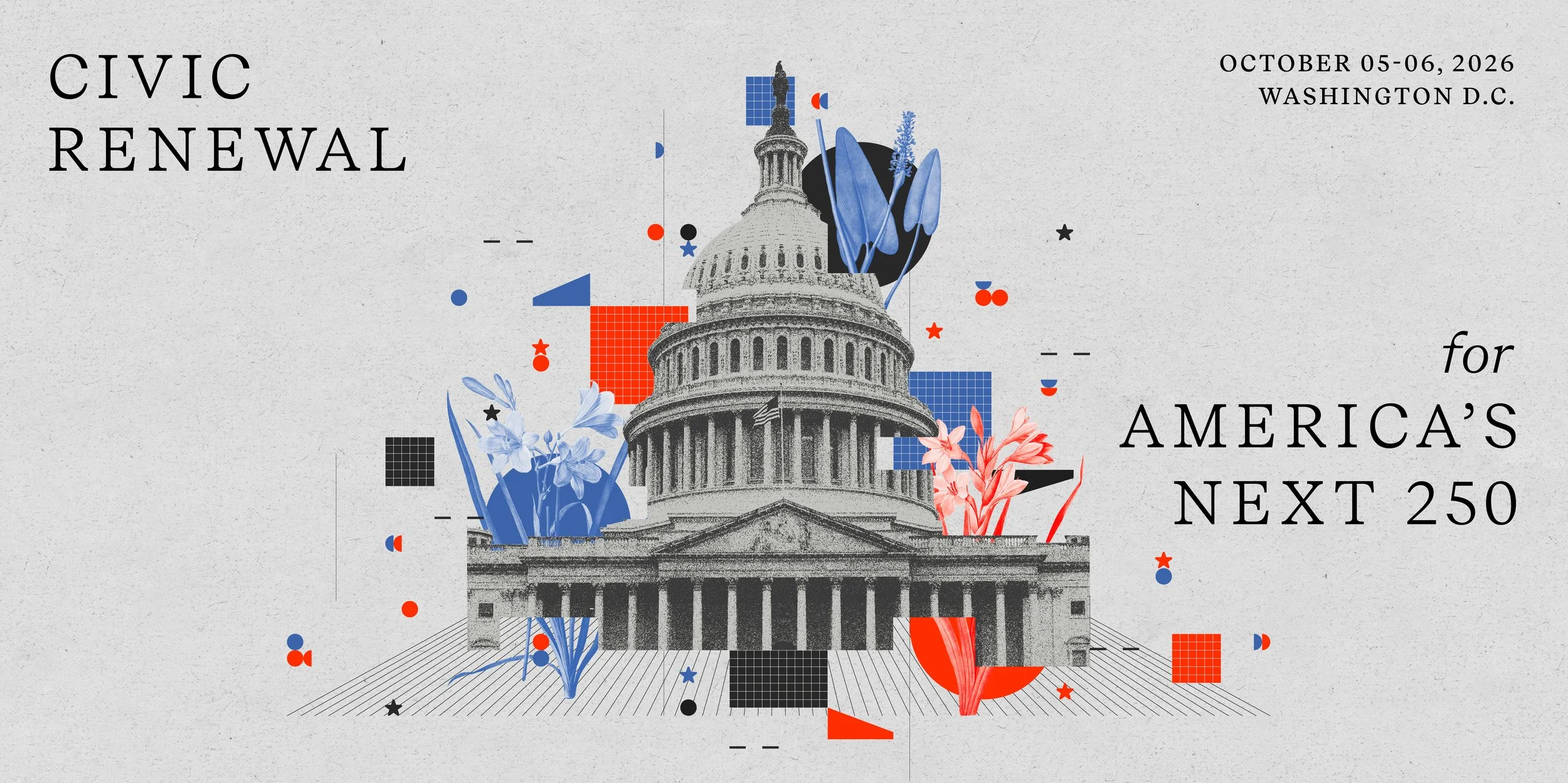
At our annual summit this October in Washington, D.C., and always, we will not deny that these debates exist, but instead express our preferential option for service over status. We will appreciate our past, and contend with our present, but we will also look ahead to our future as a people and as a nation. We will gather to consider what is required for “Civic Renewal for America’s Next 250.”
These are serious times with significant challenges. We face them with joyful confidence in the Lord. May we take up the responsibility that is ours, as we pray for the strength and courage to seek the good in our politics, as we do in all things.
Michael Wear is the President and CEO of the Center for Christianity and Public Life